 AI-First Culture
SaaS businesses thrive on cloud-native architecture, real-time data access, third-party integrations, and globally distributed teams. But with innovation comes responsibility—especially in managing and securing massive data volumes. Today, SaaS Cybersecurity is not just a technical issue; it’s a business-critical imperative.
From multi-tenant vulnerabilities and insecure APIs to account takeovers and compliance risks, SaaS security threats are evolving rapidly—putting customer trust, investor confidence, and business continuity at risk.
Looking to protect your SaaS platform against rising security concerns?
This guide covers key SaaS security threats, their impact, and effective SaaS security mitigation strategies that secure operations while enabling sustainable growth.
Let’s examine the most common SaaS security threats affecting growing software companies today:
Download our whitepaper on emerging cybersecurity threats & practical mitigation strategies NOW!
Key Cybersecurity Challenges for SaaS Businesses
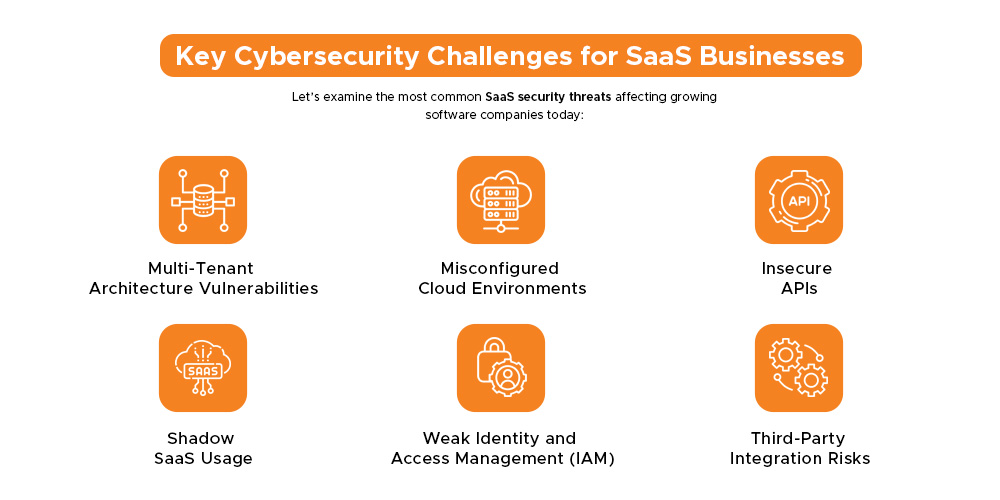
- Multi-Tenant Architecture Vulnerabilities SaaS platforms typically follow a multi-tenant structure, where different clients share the same application instance. Poor isolation can lead to data leaks or unauthorized access across accounts.
- Misconfigured Cloud Environments Misconfigurations in cloud storage buckets, IAM roles, or APIs remain a top cause of data breaches. Even minor oversight can expose sensitive customer data to public access.
- Insecure APIs APIs are central to SaaS connectivity—but improperly secured endpoints can be exploited by attackers to access internal systems or manipulate data.
- Shadow SaaS Usage Employees often use unauthorized SaaS applications without informing IT teams. This "Shadow IT" introduces unknown vulnerabilities and compliance risks.
- Weak Identity and Access Management (IAM) Without strong IAM protocols, attackers can exploit reused passwords, gain admin privileges, and execute large-scale breaches via compromised accounts.
- Third-Party Integration Risks SaaS apps rely heavily on integrations with CRMs, accounting platforms, and cloud storage tools. Any weak link in the supply chain introduces risk to the entire system.
Download our whitepaper on emerging cybersecurity threats & practical mitigation strategies NOW!
Real-World Impact of SaaS Security Threats
The damage from SaaS security threats extends beyond IT. Businesses risk:- Loss of customer trust due to data leaks
- Compliance penalties under GDPR, HIPAA, or SOC 2
- Financial disruption from ransomware or operational downtime
- Reputation damage affecting long-term brand equity
- Intellectual property theft via stolen credentials or compromised code
SaaS Security Mitigation Strategies
To counter these challenges, SaaS businesses must adopt a proactive, layered security approach. Below are essential SaaS security mitigation strategies that should form the core of your cybersecurity plan:- Implement Zero Trust Architecture Verify every access request, regardless of source or network. Assume no user or device is trustworthy by default.
- Enforce Strong Identity Management Enable Multi-Factor Authentication (MFA), Single Sign-On (SSO), and role-based access control to limit data exposure.
- Conduct Continuous Security Assessments Perform regular vulnerability scans, penetration testing, and configuration audits to identify security gaps before they’re exploited.
- Secure APIs with Tokens and Encryption Use OAuth, API keys, and HTTPS encryption for all integrations. Implement rate limiting and threat detection tools.
- Monitor User Behavior in Real-Time Use User and Entity Behavior Analytics (UEBA) to detect anomalies like credential theft or internal misuse.
- Educate Teams on SaaS Security Best Practices Cybersecurity is everyone’s job. Train employees to avoid phishing, use password managers, and report suspicious activity.
- Adopt a SaaS Security Posture Management (SSPM) Platform SSPM tools help organizations gain visibility, enforce policies, and fix misconfigurations across all connected SaaS apps.
Why SaaS Cybersecurity Must Be a Priority
In a digital-first world, every SaaS platform is a target. Unlike on-premises systems, SaaS Cybersecurity involves securing data that lives offsite, operates across borders, and is accessed by thousands of users simultaneously. The cost of ignoring cybersecurity? Data breaches cost businesses an average of $4.45 million per incident (IBM, 2024). For SaaS startups and scaleups, a breach can halt growth, damage investor relations, and result in permanent churn. Securing your SaaS stack is no longer optional—it’s your growth foundation!Key Features of a SaaS-Specific Security Framework
| Capability | Purpose |
|---|---|
| Multi-Tenant Isolation | Prevents cross-customer data leakage |
| Cloud Configuration Management | Avoids open storage or insecure permissions |
| SSPM Tools | Monitors and enforces SaaS-specific security policies. |
| DevSecOps Integration | Embeds security into the CI/CD pipeline |
| Incident Response Automation | Enables faster breach containment and recovery |
| Data Encryption at Rest & Transit | Protects sensitive data across all environments |
| Compliance Dashboards | Ensures audit readiness for GDPR, SOC 2, HIPAA, and more |
Protect What You Build
Are you building or scaling a SaaS business? Now is the time to assess your cybersecurity readiness. Book a free SaaS cybersecurity audit with our experts. We’ll help you identify vulnerabilities, recommend tools, and create a roadmap tailored to your business goals.Final Thoughts
As digital threats grow more complex, the responsibility of SaaS companies extends far beyond feature delivery. A secure SaaS experience is a competitive advantage—and a necessity. By addressing key SaaS security threats with the right mitigation strategies, companies can not only protect data but also earn customer trust, meet compliance demands, and enable growth at scale. Cybercriminals move fast. But with the right SaaS Cybersecurity strategy, you’ll always stay one step ahead.Frequently Asked Questions
Common threats include misconfigured cloud environments, insecure APIs, Shadow SaaS, and weak IAM systems.
Use token-based access, encrypted communication, SSPM tools, and monitor third-party activity continuously.
DevSecOps integrates security into development cycles—ensuring security checks are automated across the CI/CD pipeline.
SSPM tools monitor misconfigurations, enforce policies, provide alerts, and maintain compliance across all SaaS apps.
It should cover multi-tenant isolation, encryption, IAM, incident response, compliance monitoring, and DevSecOps integration.
Keep reading
Managed Detection and Response (MDR): How It Works, Key Components, and When You Need It
March 23, 2026Read
Why Are Healthcare Organizations Turning to AI Pods for HIPAA-Compliant AI Solutions?
March 11, 2026Read
Traditional AI Hiring vs AI Pods for SaaS Service: Which Model Drives Faster ROI?
March 9, 2026Read
Ready to build smarter? Let's talk.
Our experts are ready to help you turn ideas into production-ready AI, cloud and digital solutions.
Get In Touch →Get a Free Consultation
Let's Discuss Your Growth Strategy
Let's discuss how we can help you accelerate growth, improve efficiency, and drive real business outcomes.