 AI-First Culture
In 2025, the SaaS landscape will be more competitive and complex than ever before. Customers demand seamless experiences, faster updates, airtight security, and zero downtime. At the same time, SaaS platforms must support continuous innovation, global scale, and AI-driven automation , all without compromising reliability.
To meet these rising expectations, modern SaaS companies are embracing DevOps not just as a methodology, but as a strategic imperative. DevOps has evolved from a niche practice to the backbone of high-performing SaaS delivery.
This comprehensive guide dives deep into the current and future state of DevOps for SaaS applications in 2025. Whether you're launching a new product or modernizing legacy systems, mastering DevOps in 2025 is essential to staying ahead in the SaaS race.
What is DevOps in SaaS?
DevOps is a set of practices that integrate software development (Dev) and IT operations (Ops). It aims to shorten the development lifecycle while delivering features, fixes, and updates frequently in close alignment with business objectives.
When applied to SaaS platforms, DevOps for SaaS applications introduce automation, continuous delivery, and real-time monitoring into the cloud-native development environment. This improves scalability, reduces downtime, and enables faster releases with fewer errors—benefits that are critical to SaaS companies in 2025.
Discovering Why DevOps is Crucial for SaaS in 2025?
The SaaS landscape in 2025 is defined by four key pressures:
- Faster Release Cycles: Users demand frequent updates and bug fixes.
- Global Scalability: SaaS apps must scale instantly across geographies.
- Cloud-Native Complexity: Multi-cloud and hybrid deployments are now the norm.
- High Availability: Downtime can lead to revenue and customer loss instantly
SaaS DevOps 2025 addresses all of these through automation, microservices architecture, containerization, CI/CD pipelines, and real-time observability.
Download eBook: Future of DevOps 2025
Key Benefits of DevOps for SaaS Applications
- Faster Time-to-Market: CI/CD enables automatic code integration, testing, and deployment.
- Improved Collaboration: DevOps breaks down silos between teams, aligning goals and tools.
- Enhanced Quality & Reliability: Automated testing and real-time monitoring reduce bugs in production.
- Scalable Infrastructure: DevOps SaaS solutions use cloud-native tools to manage spikes in traffic or users.
- Security & Compliance: Built-in security (DevSecOps) helps with regulatory compliance and protection from cyber threats.
Core Components of SaaS DevOps in 2025
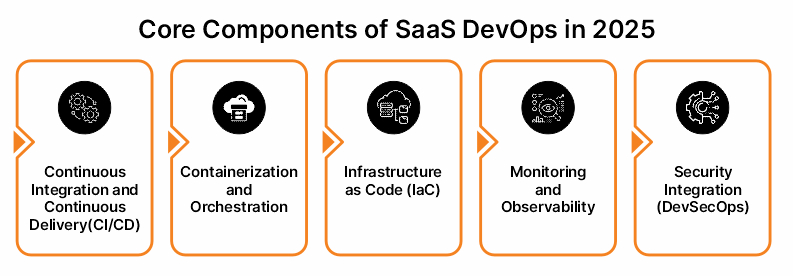
- Continuous Integration and Continuous Delivery (CI/CD)
- Containerization and Orchestration
- Infrastructure as Code (IaC)
- Monitoring and Observability
- Security Integration (DevSecOps)
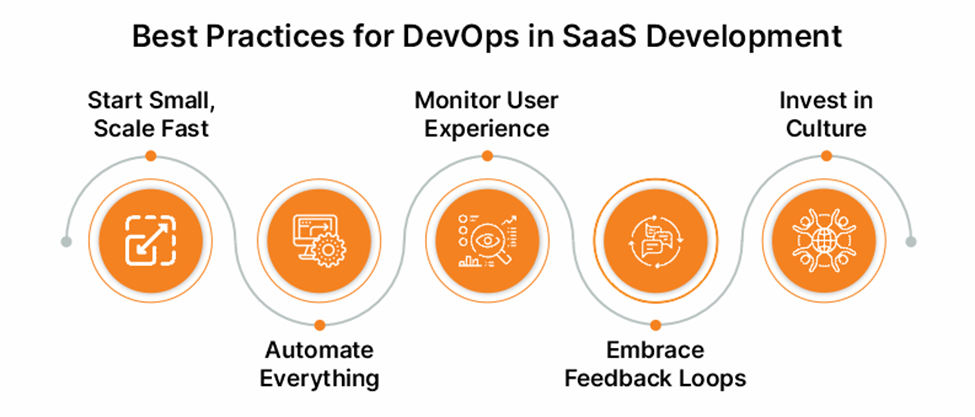
- Start Small, Scale Fast
- Automate Everything
- Monitor User Experience, Not Just Systems
- Embrace Feedback Loops
- Invest in Culture
- Build CI/CD pipelines from scratch
- Migrate legacy monoliths to microservices
- Integrate security and compliance automation
- Optimize cloud costs and performance
- Implement self-healing infrastructure and zero-downtime deployments
- AI-Powered CI/CD Pipelines: Machine learning DevOps maturity modelsare being integrated to predict failures and optimize testing sequences.
- Platform Engineering: Centralized internal developer platforms (IDPs) are reducing cognitive load and increasing developer velocity.
- GitOps:Infrastructure and application deployments are managed entirely through Git repositories.
- FinOps in DevOps: Financial accountability is being built into the DevOps pipeline to manage cloud costs effectively.
- Serverless DevOps Serverless frameworks are changing how deployments are handled, with no infrastructure management overhead.
Modern DevOps for SaaS application development emphasizes seamless CI/CD pipelines that automate building, testing, and deploying new features. This reduces manual effort, minimizes human error, and accelerates delivery.
Containers have become essential for SaaS DevOps 2025, enabling lightweight, reproducible environments. Kubernetes remains the go-to orchestration tool, automating deployment, scaling, and management of containerized applications.
IaC allows teams to define and manage infrastructure using code. This ensures consistency across environments and simplifies the provisioning and scaling of resources.
Monitoring is not just about detecting failures—it's about proactively ensuring application health. Observability tools offer deep insights into logs, metrics, and traces.
In 2025, SaaS apps must be secure at every stage of the development lifecycle.DevSecOps services embeds automated security testing into CI/CD workflows, preventing vulnerabilities from reaching production.
Best Practices for DevOps in SaaS Development
Begin with one product or microservice and implement DevOps practices incrementally. Measure the ROI and scale across teams.
From testing to deployment, automation is the key to reducing delays and human errors.
Focus on user-centric metrics such as latency, uptime, and in-app performance—these drive customer satisfaction.
Use real-time data and customer feedback to improve builds continuously
DevOps is as much about people as it is about tools. Encourage collaboration, shared ownership, and continuous learning.
Top DevOps Services for SaaS You Must Know About
Partnering with experienced DevOps service providers gives SaaS companies access to expert site reliability engineering, advanced automation frameworks, and tailored tooling strategies. The right DevOps services can help you:
Free DevOps consultation— Contact us now!
Emerging Trends in SaaS DevOps 2025
Accelerate SaaS Innovation with AI-Driven DevOps from Netsmartz
DevOps has become foundational to the success of SaaS businesses in 2025. From accelerating product innovation to improving uptime and reducing operational costs, the right DevOps strategy helps you stay agile, scalable, and secure in a competitive landscape.
Whether you're looking to build a SaaS MVP or manage a multi-region SaaS product, embracing DevOps for SaaS applications is non-negotiable. With the right practices, tools, and partners, you can transform your software delivery and drive sustainable growth in the years to come.
With 25+ years of excellence, Netsmartz offers tailored DevOps services designed to optimize software delivery, reduce release cycles, and embed security and scalability from day one. From setting up CI/CD pipelines to managing Kubernetes clusters and cloud cost optimization, our AI-powered DevOps frameworks are built for SaaS success.
Frequently Asked Questions
DevOps in SaaS refers to the application of DevOps practices—like CI/CD, automation, and monitoring—in developing and operating software-as-a-service platforms. It ensures faster deployment, high availability, and continuous improvement.
DevOps enables SaaS companies to release features quickly, scale efficiently, reduce downtime, and respond to customer feedback in real time. This agility is crucial to staying competitive in 2025.
Popular tools include Docker and Kubernetes for containerization, Jenkins and GitHub Actions for CI/CD, Terraform for IaC, and Prometheus and Datadog for monitoring.DevSecOps tools like Snyk also help secure the pipeline
bsolutely. Even small teams can leverage DevOps to automate tasks, reduce errors, and scale faster. Starting small with CI/CD and cloud-native practices can make a big impact.
DevOps SaaS solutions are cloud-based platforms that offer integrated services for code integration, delivery automation, infrastructure provisioning, monitoring, and security. These tools help SaaS businesses streamline operations without managing on-premises infrastructure.
DevOps enhances SaaS performance through continuous monitoring, automated testing, and scalable infrastructure. This allows for faster detection and resolution of performance bottlenecks, ensuring smooth user experiences and reliable uptime.
AI plays a key role in SaaS DevOps 2025 by optimizing CI/CD pipelines, predicting system failures, automating anomaly detection, and recommending performance improvements. It reduces manual effort and enhances the speed and intelligence of DevOps workflows.
Keep reading
Managed Detection and Response (MDR): How It Works, Key Components, and When You Need It
Azure Migration Services: A Strategic Roadmap for Secure and Scalable Cloud Adoption

Microsoft Azure Cloud Adoption Framework: ROI, Compliance & Scalability in the UAE
Ready to build smarter? Let's talk.
Our experts are ready to help you turn ideas into production-ready AI, cloud and digital solutions.
Get in touch →Let's Discuss Your Growth Strategy
Let's discuss how we can help you accelerate growth, improve efficiency, and drive real business outcomes.